Most sofa care guides are written for temperate climates. Wipe occasionally. Condition once a year. Keep out of direct sunlight. Job done.
In Malaysia, that's not the full story.
Average humidity around 81%, daily temperatures above 28°C, a culture where food happens in the living room, and homes shared with children, cats, and regular guests — these conditions mean your sofa needs more deliberate, more frequent, and more climate-aware care than a generic guide suggests.
This is the guide Malaysian sofa owners actually need. It covers every major material, the two climate threats specific to our environment, a stain-by-stain emergency reference, and the cushion maintenance most people ignore until it's too late.
See [our full sofa material guide for Malaysian homes /blog/sofa-material-guide-malaysia] for a complete comparison of how each material performs in Malaysian conditions before choosing your next sofa.
See [our complete Malaysian living room furniture guide /blog/the-complete-malaysian-living-room-furniture-guide-2026] for the full room planning and furniture selection framework.
Why Malaysian Homes Need a Different Approach to Sofa Care
Three conditions in Malaysian homes accelerate sofa wear faster than in most other climates: high ambient humidity, AC thermal cycling, and food culture. Understanding these three pressures shapes every care decision in this guide.
High ambient humidity. At 81% average annual humidity, moisture is constantly present in your living space. Without adequate ventilation, this moisture is absorbed by upholstery fibres and foam, leading to musty odours, accelerated fabric degradation, and — in worst cases — surface mould on neglected leather or trapped-moisture fabrics.
Thermal cycling from air conditioning. Malaysian homes frequently cycle between outdoor heat (30°C+) and heavily air-conditioned interiors (18–22°C). This repeated expansion and contraction is particularly hard on genuine leather, which can dry and crack faster than in consistently moderate climates. It is also why leather conditioning needs to occur every 3–4 months in Malaysia rather than the once-a-year schedule recommended for temperate climates.
Food culture. Malaysian living is food-centric — teh tarik, nasi lemak, and mee goreng happen on sofas. Oil-based food stains and curry residue are among the hardest stains to remove from upholstery, and they set faster in our climate than in cooler countries. Speed of response matters more here than anywhere else.
The One Rule That Applies to Every Sofa, Every Material
Blot immediately. Never rub.

For any liquid spill on any material, the single most important action is immediate blotting with a clean, dry, white cloth — white so you can see whether colour is transferring. Press firmly and lift — do not rub sideways, which spreads the stain laterally and pushes liquid deeper into the fibres.
This one habit — acting within the first 30 seconds of a spill — prevents more permanent sofa damage than any cleaning product or maintenance routine. It applies to water, oil, coffee, sauce, and everything in between.
Everything else in this guide builds on that foundation.
Understanding Your Sofa's Cleaning Code
Before applying any product to your sofa, check the cleaning tag — usually found under seat cushions or on the underside of the sofa frame. The code tells you what cleaning agents are safe for your specific fabric.
Code | What It Means | Safe Cleaning Methods | Common Fabric Types |
|---|---|---|---|
W | Water-based cleaning safe | Water, mild liquid soap, upholstery foam cleaner | Most synthetic performance fabrics, polyester blends |
S | Solvent only — no water | Dry-cleaning solvent products only. Water causes permanent water rings, shrinkage, or distortion | Natural fibres: linen, cotton, some wools |
W/S | Water or solvent — either safe | Try water-based cleaning first; use solvent if needed. Most flexible code | Many mixed-fibre upholsteries |
X | Vacuum or brush only | No liquid cleaning of any kind. Professional cleaning only for stains | Delicate decorative fabrics — less common |
FRWD WhatsApp support: If your FRWD sofa has no visible tag or the tag is worn, contact our team before attempting any liquid cleaning. Reach us at [WhatsApp] with your order details and we'll confirm the correct cleaning code and method for your specific piece.
Routine Care by Material

Six materials, six different routines — all built around the same blot-first principle. Pre-purchase readers: the maintenance requirements below are a practical guide to what each material actually demands in daily Malaysian life.
See [our full sofa material guide for Malaysian homes /blog/sofa-material-guide-malaysia] for a complete 7-material comparison with humidity performance ratings, price ranges, and lifestyle-based recommendations.
Genuine Leather
Leather needs the least frequent intervention but the most consistent routine. Neglect over time is what causes cracking and mould — both preventable with a simple schedule.
Weekly:
• Wipe down with a soft, dry microfibre cloth to remove surface dust and skin oils — these accumulate and degrade the leather surface gradually if left.
• In humid months (October–January for most of Peninsular Malaysia): check for early mould signs — pale, powdery, or slightly fuzzy patches — particularly at seams and the back of cushions.
Monthly:
• Wipe with a lightly damp cloth (no soap) to remove accumulated grime from high-contact areas — seat centres, armrests, headrest zones. Dry immediately; never leave leather wet.
Every 3–4 months:
• Apply a leather conditioner appropriate for your leather type. Conditioning replenishes the natural oils that humidity fluctuations and AC cycling draw out, keeping the leather supple and preventing cracking. Malaysia's AC cycling makes this 3–4 months the correct interval — not the once-a-year schedule appropriate for temperate climates.
• Always test conditioner on a hidden area first. Use a conditioner labelled for your leather type — aniline leather requires gentler formulations than pigmented leather.
• Do not over-condition. Applying conditioner too frequently creates a greasy film that attracts dust.
What to avoid: Baby wipes, wet wipes, or any product containing alcohol, bleach, or ammonia — these strip the leather's protective finish. Direct AC airflow onto the surface causes uneven drying. West-facing afternoon sun through unfiltered windows is the fastest way to fade and crack leather in Malaysian homes.
Leathaire & PU Leather
Both materials are significantly more forgiving than genuine leather, but they have different care requirements.
Leathaire (nanotech synthetic):
• Weekly wipe with a damp microfibre cloth is all that's needed for routine maintenance.
• For spills: blot immediately, then wipe with a cloth dampened with mild soap and water. Dry the area promptly.
• Unlike genuine leather, leathaire does not require conditioning — its synthetic structure does not absorb or lose oils the way natural hide does.
• Avoid abrasive scouring pads or harsh chemical sprays, which can degrade the surface coating over time.
PU Leather:
• Care is similar to leathaire but PU leather is more vulnerable. The polyurethane coating is the first thing that degrades — once cracking or peeling begins, it cannot be reversed, only slowed.
• Keep PU leather surfaces dry. Prolonged moisture — wet clothing against the surface, damp rooms without ventilation — accelerates the peeling process.
• Apply a light furniture polish or PU leather conditioner every 6 months to slow surface degradation — this extends life but does not prevent eventual peeling.
Performance Fabric & Woven Polyester
The most low-maintenance material category. Performance fabric is engineered to resist staining, handle cleaning, and tolerate Malaysian conditions without special treatment.
Weekly:
• Vacuum with an upholstery attachment, including under and between cushions. This prevents dust and hair from becoming embedded in the weave.
As needed (spills):
• Blot immediately. For most performance fabrics (W or W/S code): mild dish soap diluted in warm water, applied with a clean white cloth and blotted dry, handles the vast majority of stains.
• For oil-based stains (cooking oil, curry, roti canai): sprinkle baking soda or cornstarch onto the stain first, let sit for 15 minutes to absorb the oil, brush off gently, then clean with the soap-water solution.
Every 3–6 months:
• Wash removable covers on a gentle cycle with cold water. Air dry only — tumble drying can shrink or distort fabric covers.
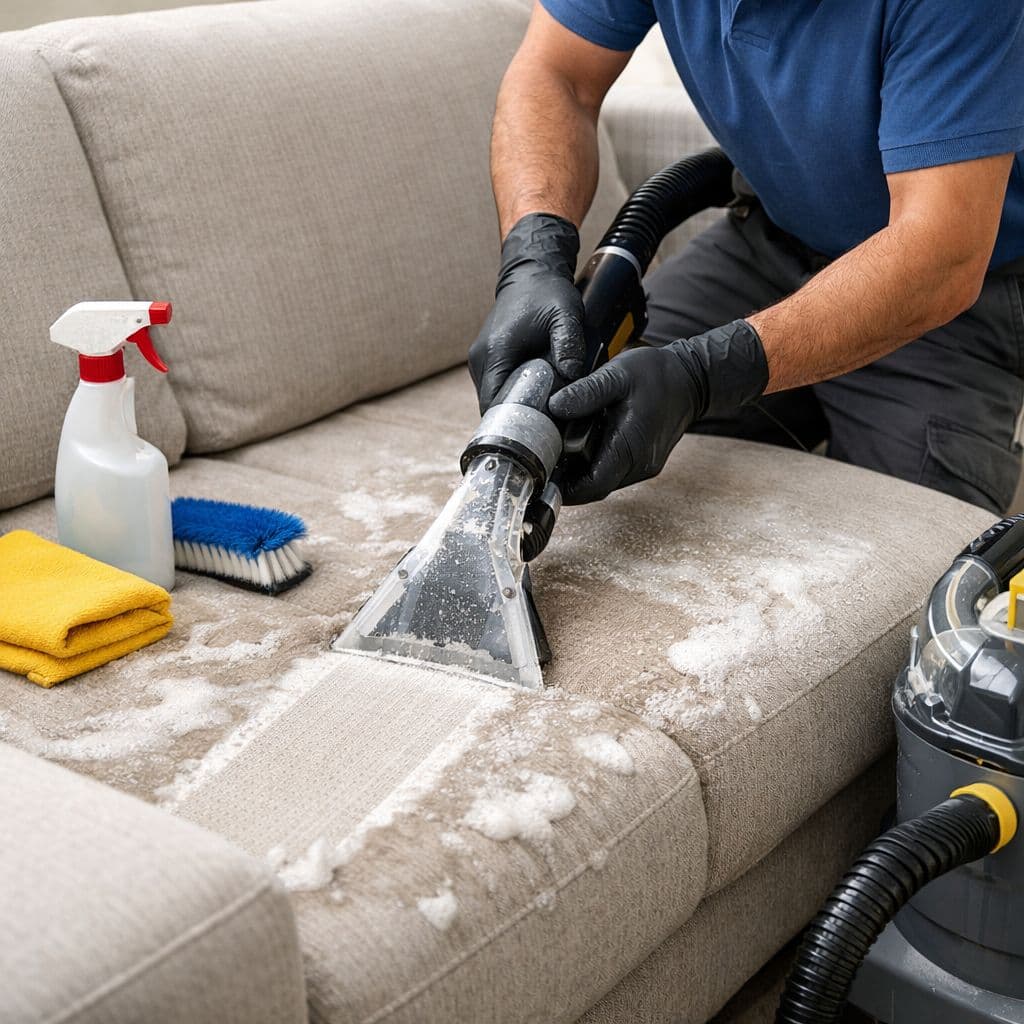
• For non-removable covers: a gentle steam clean (if the care code permits) refreshes the fabric and kills dust mites, which accumulate in Malaysian humidity.
What to avoid: Harsh bleach-based cleaners (unless specifically indicated). Scrubbing vigorously — this causes pilling on woven fabrics. Always blot and pat rather than rub.
Linen & Cotton
Natural fibre sofas are beautiful but the most demanding to maintain in Malaysia's climate. They reward attentive care and suffer most from neglect.
Weekly:
• Vacuum thoroughly with a soft brush attachment. Natural fibres attract and hold dust more readily than synthetics — in Malaysia's urban air, this matters.
Immediately (spills):
• Act within seconds. Linen and cotton are highly absorbent — liquids set fast, particularly oil-based food stains.
• Most linen and cotton upholstery carries an S cleaning code — water-based cleaning risks water rings. Use a dry-cleaning solvent spray for spot treatment. When in doubt, call a professional.
• If the fabric carries a W or W/S code: use cold water only — hot water can cause natural fibres to shrink.
Every 3–6 months:
• Wash removable covers on a delicate cycle in cold water. Air dry flat to prevent shrinkage. Never tumble dry.
• Consider applying a fabric protector spray to create a light barrier against spills. Reapply after each wash.
• In poorly ventilated rooms: if the sofa develops a faint musty smell (common during monsoon season), sprinkle baking soda generously over the fabric, leave for several hours, then vacuum thoroughly. This neutralises odour without liquid.
Velvet (Standard and Performance)
Velvet requires more consistent attention than flat-weave fabrics, but well-maintained velvet is surprisingly durable.
Cardinal rule for velvet: Always brush in the direction of the pile. Velvet has a nap — a directional grain — and cleaning or brushing against it flattens the pile permanently and creates visible marks.
Weekly:
• Vacuum with a soft brush attachment, moving in the direction of the pile. Use a dedicated velvet brush to restore any compressed areas — armrests and seat centres are most prone to pile flattening.
Immediately (spills):
• Blot from the outside inward with a clean, dry cloth.
• For water-safe velvet (W code): dampen a cloth lightly and dab — never rub — then air dry naturally. Do not use a hair dryer; heat can permanently damage the pile.
• For pile compression after a spill: once completely dry, hold a clothes steamer 10–15 cm above the surface. Steam lightly — the steam lifts the pile. Brush gently in the pile direction while still warm.
Every 3–6 months:
• Steam clean (if care code permits) to refresh fibres and lift embedded dust. Professional upholstery steam cleaning is recommended for full sofas.
• Standard velvet in rooms without consistent AC: check for odour retention. Baking soda treatment (sprinkle, wait, vacuum) handles mild odours without liquid.
Bouclé & Teddy Fabric
Bouclé requires the most intentional care of any material. Its looped yarn structure is both its greatest aesthetic strength and its greatest maintenance challenge.
Golden rule for bouclé: Never scrub, never rub, never use a stiff brush. The loops snag and pull with any aggressive lateral movement, permanently distorting the surface texture.
Weekly:
• Vacuum with a soft brush or upholstery attachment at low suction. Move slowly and gently. High suction or harsh attachments will pull loops out of the weave.
• Check for any pulled loops — a single snagged loop can be carefully tucked back using a blunt needle or the flat end of a pin. Do not cut it unless the loop is completely detached.
Immediately (spills):
• Blot immediately. The loop structure means liquid travels quickly into the base fabric — speed matters more with bouclé than with any other material.
• For oil-based stains: apply baking soda or cornstarch to absorb the grease before any liquid cleaning. Leave for 15–20 minutes, then brush off gently with a soft-bristled toothbrush — very gently, in line with the loops.
• Apply cleaning solution with a damp cloth using a dabbing motion only. Work from the outer edge of the stain toward the centre.
• Allow to air dry completely. Bouclé must never be machine dried or left damp — mould can develop in the loop structure faster than in flat fabrics.
Every 3–6 months:
• Professional upholstery cleaning is strongly recommended for bouclé that has seen regular use. The loop structure traps dust and oils at a level that home vacuuming alone cannot fully address.
Teddy fabric (sherpa/teddy fleece): Similar care to bouclé but the pile is softer and even more prone to matting. Avoid sitting in the same spot repeatedly without rotating. If the teddy pile becomes matted, a soft pet brush run gently across the surface can help restore the texture.
Dealing with Malaysia's Two Biggest Sofa Enemies
Humidity and Mould Prevention

Mould on a sofa is not a sign of poor quality — it is a sign of inadequate airflow in a tropical climate. Prevention is straightforward; treatment is harder.
Prevention:
• Ensure 10–15 cm of clearance between the sofa and any wall. Air needs to circulate behind and beneath the piece.
• In rooms that cycle between heavy AC and closed overnight conditions: consider a small dehumidifier or silica gel packs placed near the sofa base to manage the humidity spike when the AC is off.
• During the monsoon season (roughly October–January for Peninsular Malaysia's east coast; November–February for the west coast): increase ventilation frequency. Open windows when it isn't raining to allow airflow.
• Rotate and flip cushions monthly. The underside of cushions — trapped against the base — is the most common site for early mould growth.
If you find mould — act immediately. Mould spreads.
• For fabric: brush loose spores off outdoors (wear a mask), then treat with a diluted white vinegar solution (equal parts vinegar and water) on a cloth, dabbing — not rubbing — the affected area. Air dry fully in a well-ventilated spot with indirect natural light. Apply baking soda afterward to neutralise any remaining odour.
• For leather: wipe the affected area with a small amount of white vinegar on a cloth, dry immediately, then apply leather conditioner once completely dry.
• If mould has penetrated the foam or is widespread: professional upholstery cleaning is necessary. Surface treatment will not address the underlying issue.
Food and Liquid Stains (The Malaysian Kitchen Reality)
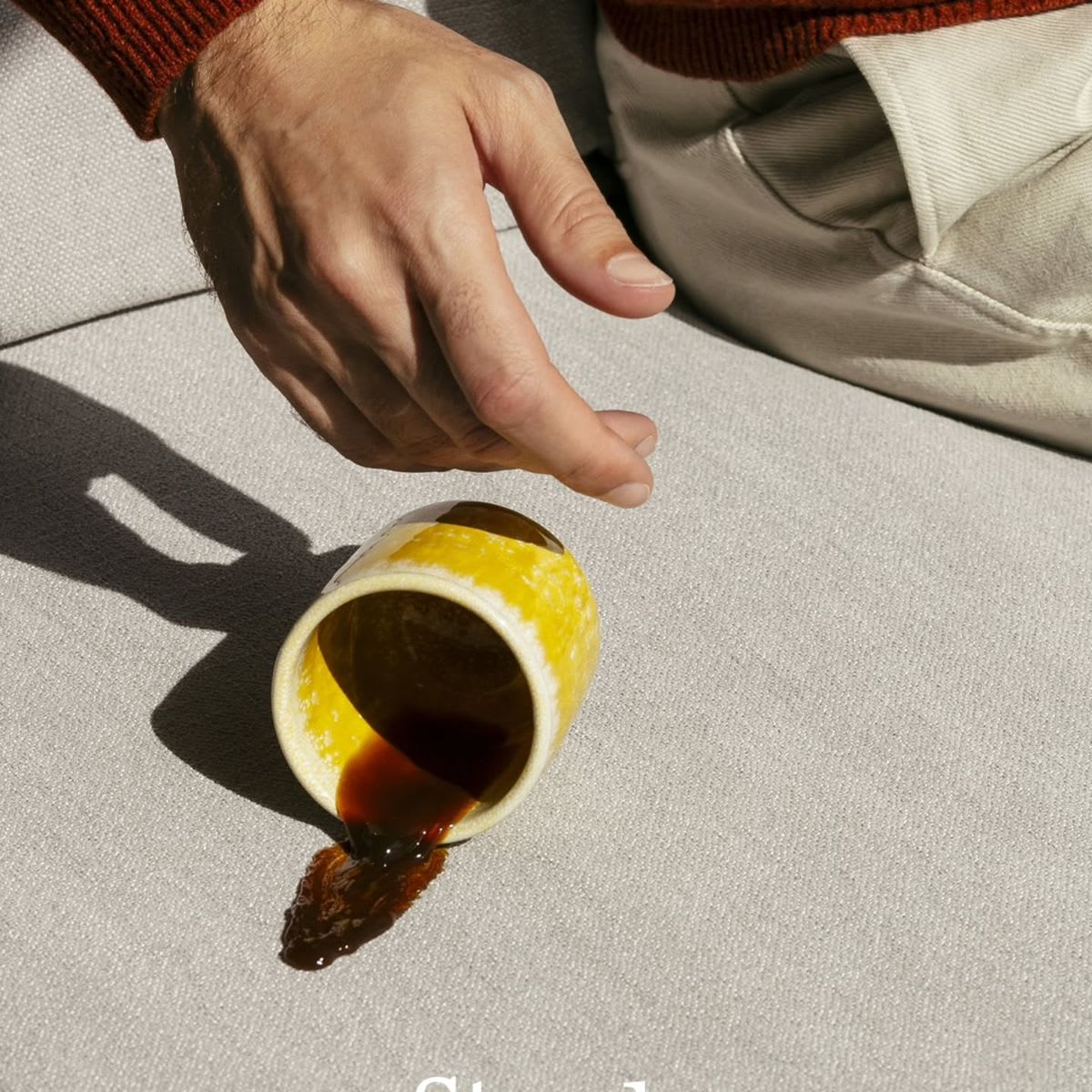
Malaysian food is fragrant, flavourful, and notoriously hard on upholstery. The stain emergency table below covers 11 common stains — but the principle is the same for all of them: act within 30 seconds, blot never rub.
Curry and sambal: Oil-based with pigment. Baking soda or cornstarch first to absorb oil. Then cold soap-water (W-code) or solvent cleaner (S-code). Avoid hot water — it sets the pigment. For deep-set curry stains, a diluted enzymatic cleaner (available at pharmacies) breaks down the food compounds more effectively than soap alone.
Kopi and teh tarik: Tannin-based stains. Blot immediately, then treat with cold water and a small amount of white vinegar on W-coded fabrics. Hot water or heat sets tannin stains permanently — always use cold.
Durian: Odour is the primary issue rather than staining. Baking soda treatment (generous application, 3–4 hours, vacuum) is highly effective for neutralising durian odour from fabric. For leather, a damp wipe followed by conditioner application handles both the surface residue and the smell.
Stain-by-Stain Emergency Guide
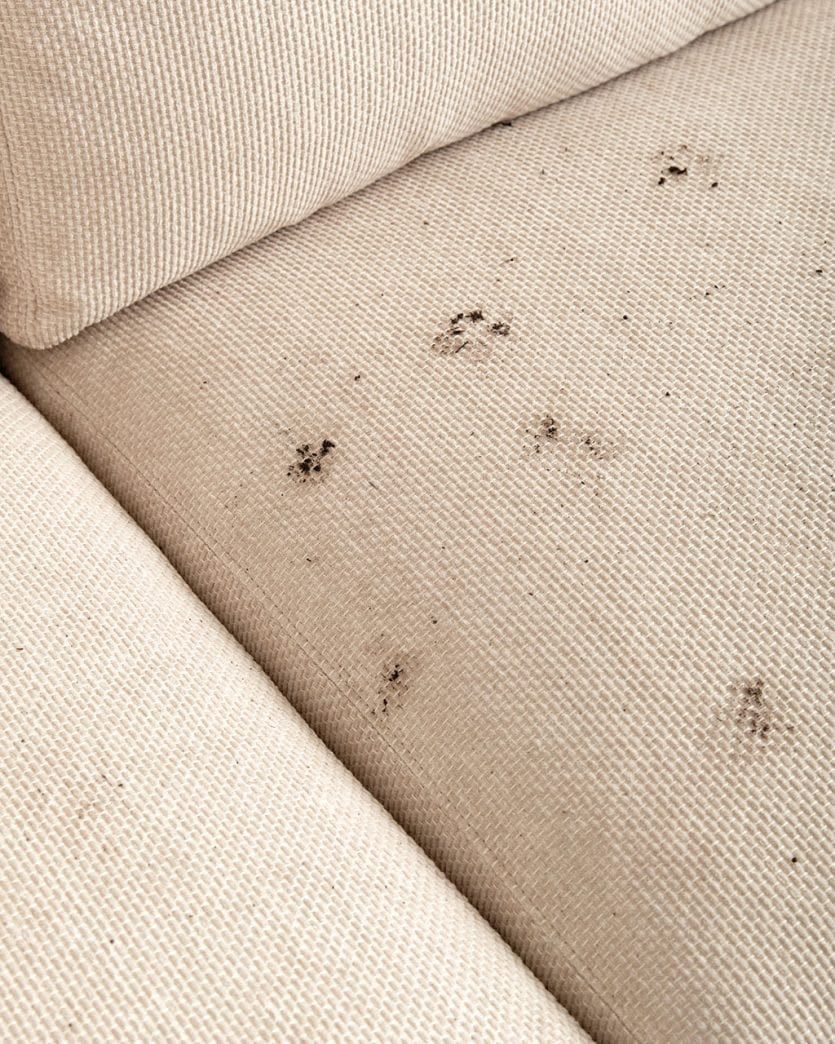
Quick-reference for the 11 most common Malaysian sofa stains. The 'Never Do' column is as important as the treatment — certain wrong actions permanently set stains that could otherwise be removed.
Stain | First Action | W-Code Treatment | S-Code Treatment | Never Do |
|---|---|---|---|---|
Coffee / Teh tarik | Blot immediately | Cold water + white vinegar | Dry-cleaning solvent | Hot water (sets tannin) |
Curry / Sambal | Baking soda first to absorb oil | Cold soap-water solution | Solvent cleaner | Hot water; scrubbing |
Cooking oil | Baking soda or cornstarch (15 min) | Dish soap + cold water | Solvent spray | Rubbing; hot water |
Red wine | Blot, then cold water | Club soda or diluted salt water | Solvent cleaner | Hot water; white wine (myth) |
Blood | Cold water only — never hot | Cold water + hydrogen peroxide (test first) | Cold water blot then solvent | Hot water (sets protein permanently) |
Ink / Pen | Blot — don't spread | Rubbing alcohol on cloth, dab gently | Dry-cleaning solvent | Water (spreads ink further) |
Pet urine | Blot and dilute immediately | Enzymatic cleaner (urine-specific) | Enzymatic cleaner | Letting it dry (odour sets) |
Chocolate / Ice cream | Scrape solids gently, then blot | Cold soap-water | Solvent | Hot water |
Durian | Scrape residue; baking soda for odour | Baking soda odour treatment + cold soap | Baking soda then solvent | Rubbing flesh into fabric |
Sunscreen / Lotion | Baking soda to absorb | Dish soap (cuts oil base) | Solvent spray | Scrubbing |
Nasi lemak | Scrape solid residue with flat card | Mild soap solution | Solvent cleaner | Hot water |
Always test any cleaning solution on a hidden area before applying to a visible stain — even solutions marked as safe for your fabric code.
Seasonal and Annual Deep Care Checklist
Four maintenance frequencies cover the full care cycle for a Malaysian sofa. Most owners complete the weekly steps and skip the quarterly and annual ones — which are the steps that determine whether the sofa lasts 5 years or 12.
Monthly (15 minutes):
• Vacuum all surfaces including beneath and between cushions
• Rotate and flip cushions — distribute wear evenly
• Check underside of cushions for early mould signs
• Spot clean any visible marks
Every 3 months:
• Condition genuine leather (skip if leathaire or synthetic fabric)
• Steam refresh fabric or velvet sofas if the care code permits
• Check and tighten any visible screws or sofa feet
• Wash removable covers if available — cold, gentle cycle, air dry
Every 6 months:
• Deep vacuum including inside crevice seams
• Apply fabric protector spray to natural fibre sofas
• Inspect frame joints for any loosening or creaking
• Check all cushion foam for signs of compression — press firmly and observe recovery speed
• Full clean and condition cycle for genuine leather
Annually:
• Book a professional upholstery clean — particularly for bouclé, velvet, or any sofa that sees heavy daily use (RM150–RM400 depending on size and fabric in Klang Valley)
• Assess whether cushion refilling is needed — see section below
• Rotate or rearrange the sofa position if possible to equalise sun and airflow exposure
When to Call a Professional (and What to Ask For)
Some situations are beyond DIY care — and attempting them without the right equipment can make things worse.
Call a professional when:
• Mould has spread beyond a small surface patch — deep foam mould requires extraction equipment
• A stain has set (left for 24+ hours without treatment) on a delicate fabric
• Your sofa has a strong persistent odour that baking soda hasn't resolved
• The fabric is S or X code and you have a significant stain
• You have bouclé or velvet with multiple stains and the surface texture needs restoring
What to ask a professional upholstery cleaner:
• Confirm they have experience with your specific fabric type — bouclé in particular requires specialists who understand loop fabrics.
• Ask whether they use dry-cleaning methods, steam, or water extraction — ensure it matches your fabric's care code.
• Ask whether they offer fabric protection treatment after cleaning — worth adding if available.
Typical professional sofa cleaning in Malaysia: RM150–RM400 depending on size and fabric. Worth doing annually for a sofa you've invested in — the cost of one professional clean is significantly less than premature replacement.
Extending Cushion Life: The Often-Ignored Half of Sofa Maintenance
Most people maintain the upholstery and ignore the cushion foam beneath it. The cushion is what determines how comfortable your sofa remains over time — and it is replaceable.
Rotation is essential. If you always sit in the same spot — the corner nearest the TV is a classic — that seat cushion is taking 100% of the load. The foam will compress and lose resilience significantly faster than adjacent cushions. Rotate seat cushions monthly — swap left and right, flip upside down if they're reversible.
Plumping and reshaping. Fibre-filled back cushions need regular hand-shaping — squeeze, rotate, and fluff them when you vacuum. Foam seat cushions that have slightly softened can be encouraged to recover by standing them upright outside the sofa for a few hours — gravity releases compressed foam and allows partial recovery.
When foam is genuinely spent. Foam that has compressed permanently — where you sit and feel the base before the foam provides meaningful support — can be replaced without buying a new sofa. A local upholstery workshop can cut new high-density foam inserts (ask for 35 kg/m³ or above) to your cushion dimensions. This service is common in Malaysia and underused. For a sofa with a good frame and fabric in reasonable condition, foam refilling at RM200–RM600 is one of the best-value maintenance investments available.
Habits that accelerate foam degradation: Sitting consistently on the very edge of cushions (concentrates load on one spot). Jumping or standing on seat cushions. Leaving heavy objects on cushions for extended periods. Consistently folding into one extreme position (deep slouch) without varying seating posture.
Have a specific care question about your FRWD sofa? Our team is reachable via WhatsApp and can advise on material-specific care for any piece you've purchased. [Contact us → via WhatsApp]
Not yet an FRWD customer? [Browse our sofa collection →] or [Book a free ID consultation →] to find a piece that fits your space, lifestyle, and maintenance preferences.
Interior Designer · FRWD Furniture
Laila is a furniture and interiors specialist at FRWD Furniture's Bangsar Experience Centre, with expertise in contemporary design trends, material finishes, and creating spaces that balance aesthetics with everyday function.
Frequently Asked Questions
1.How often should I clean my sofa in Malaysia?
How often should I clean my sofa in Malaysia?
Light vacuuming weekly and immediate spill treatment are the baseline. Monthly spot checks for mould (particularly on leather and bouclé), quarterly conditioning for leather, and an annual professional clean for heavily used sofas is a realistic maintenance schedule for Malaysian conditions.
2.How do I stop my sofa from getting mouldy?
How do I stop my sofa from getting mouldy?
Ensure 10–15 cm of clearance from walls, rotate cushions monthly to expose undersides to airflow, run a dehumidifier in rooms with poor ventilation, and increase ventilation during monsoon months. Regular vacuuming also removes the organic matter that mould feeds on.
3.Can I use Dettol or household disinfectants on my sofa?
Can I use Dettol or household disinfectants on my sofa?
Not directly on upholstery. Most household disinfectants contain alcohol, bleach, or ammonia — all of which damage leather, strip synthetic coatings, discolour fabrics, and degrade foam. If you need to disinfect, use a diluted fabric-safe disinfectant spray and test on a hidden area first. For leather, apply and wipe off quickly — do not allow to sit on the surface.
4.My leather sofa has white spots — is it mould?
My leather sofa has white spots — is it mould?
Very likely, yes. White, pale, or slightly powdery patches on leather in Malaysian homes are almost always mould. Treat with white vinegar on a cloth (dab, don't rub), dry thoroughly, and apply leather conditioner. Address room ventilation to prevent recurrence.
5.How do I remove pet hair from my sofa?
How do I remove pet hair from my sofa?
For flat-weave and smooth surfaces (leather, leathaire, performance fabric): a damp rubber glove run across the surface collects pet hair effectively. For velvet: use a lint roller, moving with the pile direction. For bouclé: a damp cloth or slightly damp sponge, pressed lightly and lifted (not rubbed), picks up surface hair without snagging loops. Avoid vacuum attachments with rotating brushes on loop fabrics.
6.My sofa cushions are sagging — can they be fixed?
My sofa cushions are sagging — can they be fixed?
Yes, in most cases. If the sofa frame is still solid, foam insert replacement is a cost-effective solution. Contact a local upholstery workshop with your cushion dimensions and ask for high-density foam (35 kg/m³ or above) replacements. This extends your sofa's functional life by several years at a fraction of replacement cost — typically RM200–RM600 for a full set of seat cushions.
7.Is it safe to steam clean my sofa?
Is it safe to steam clean my sofa?
It depends on the care code. Steam cleaning is appropriate for most W and W/S coded fabrics and is an excellent way to deep clean and kill dust mites in Malaysian homes. It should not be used on S-coded or X-coded fabrics, or on certain velvet types where heat can damage the pile. Always confirm the care code before steaming.
8.How long should a well-maintained sofa last in Malaysia?
How long should a well-maintained sofa last in Malaysia?
With consistent care, a mid-range sofa (kiln-dried frame, 35+ kg/m³ foam) can remain comfortable and structurally sound for 8–12 years. Premium leather sofas with proper conditioning have been known to last 20+ years. The weakest link is almost always the foam cushioning — which can be replaced — rather than the frame or fabric.