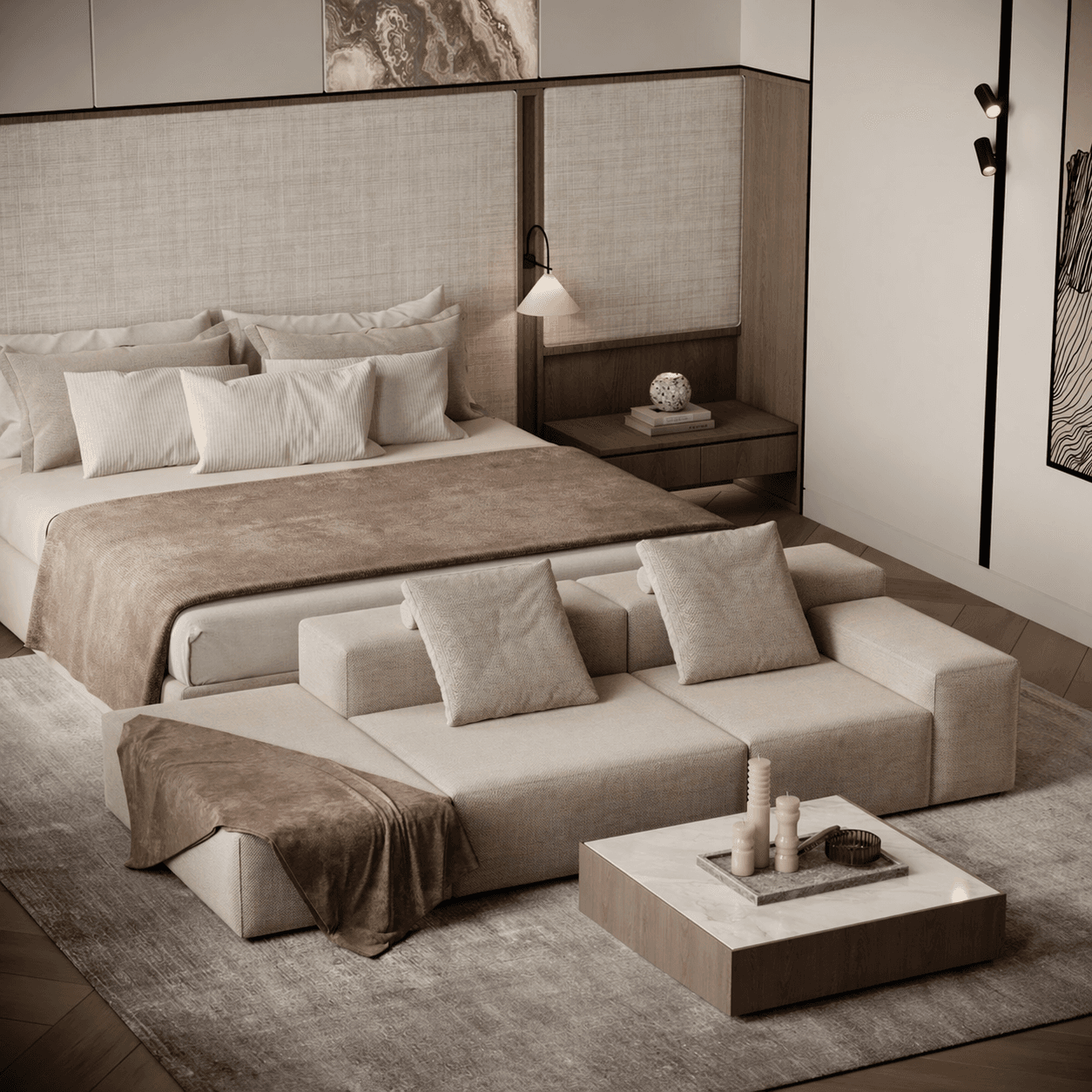
The living room sofa gets most of the attention — and for good reason. But the bedroom and study room sofa serve specific purposes that call for different thinking about size, type, comfort, and material. This guide covers the two rooms that are most often overlooked.
See [our Living Room Layout Guide for Malaysian Condos /blog/living-room-layout-malaysia-condo] for the complete framework covering living room clearance rules, layout options, and furniture arrangement — including the combined living-dining configuration.
See [our complete Malaysian living room furniture guide /blog/the-complete-malaysian-living-room-furniture-guide-2026] for the full room planning and furniture selection framework.
Part 2 - Sofa for the Bedroom (Bilik Tidur)

Photo by Pinterest
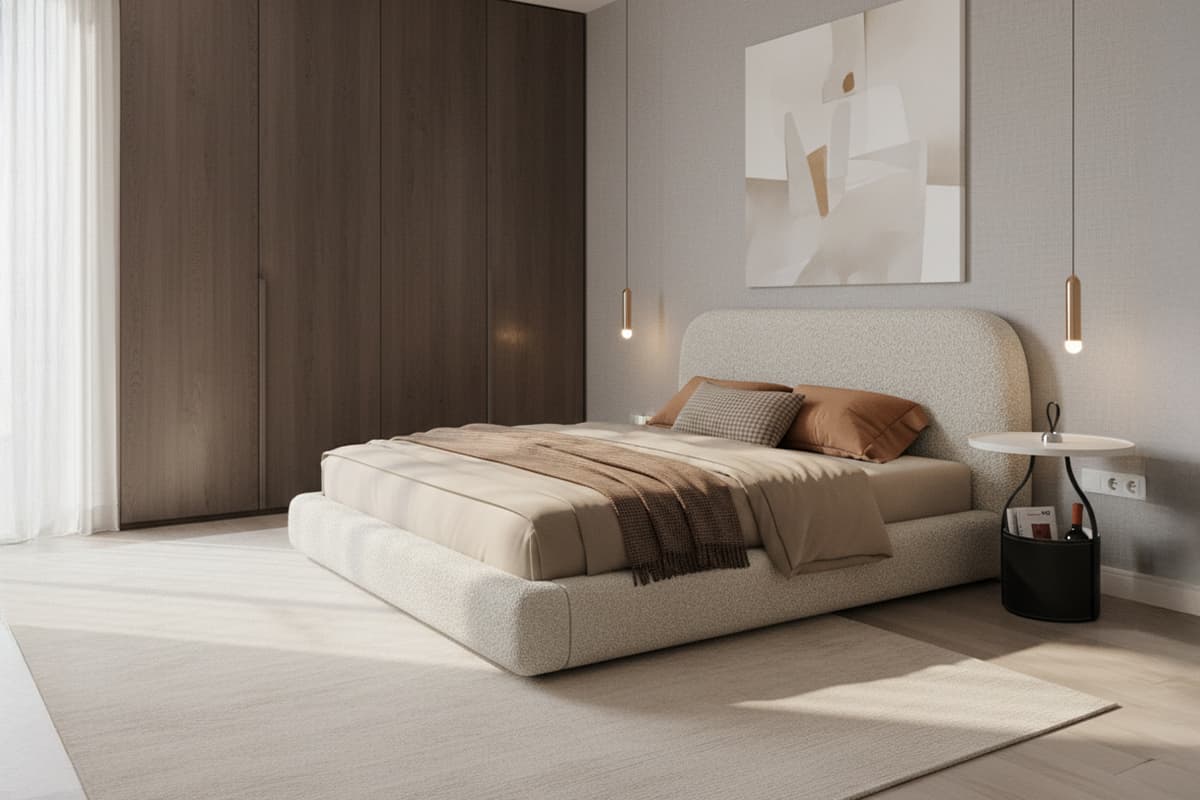
A sofa in the bedroom is less common in Malaysia than in Europe or North America, but it's becoming a more considered choice — particularly in master bedroom designs where there's enough floor space and the homeowner wants to create a distinct reading or dressing area.
When Does a Bedroom Sofa Make Sense?
A bedroom sofa makes genuine sense in three situations.
The first is the large master bedroom — typically 15 square metres or more — where a sofa creates a second zone within the room: a reading chair or small two-seater near the window, a bench or chaise at the foot of the bed. In this context, the sofa completes the room rather than crowding it.
The second is the guest bedroom in a landed property. A small sofa bed in a well-appointed guest bedroom serves two functions: daytime seating when the room is used as a study or dressing room, and an emergency extra bed when multiple guests stay.
The third is the home that doesn't have a dedicated study room — the bedroom doubles as a workspace, and a compact sofa or armchair creates a distinct reading zone that's separate from the desk and bed. Psychological separation of zones within a room genuinely affects how well you sleep and how effectively you work.
If your master bedroom is under 12 square metres, a sofa is very likely to crowd the room. Confirm the measurement before proceeding. A single armchair is the maximum viable seating addition in a bedroom that is already fitted with a king or queen bed and wardrobes.
Which Sofa Types Work in a Bedroom?

Photo by Pinterest
Not all sofa configurations translate well into a bedroom context. The types that work:
• Armchair or single seater: The most space-efficient bedroom seating option. A well-chosen armchair — a low-profile accent chair in a complementary fabric, or a swivel reading chair — occupies minimal floor space while providing a genuine seating alternative to the bed. Scale matters: a statement lounge chair with wide arms is better suited to a large master suite; a slender armchair with a higher back is better for a smaller room.
• Two-seater (loveseat): The largest configuration that works comfortably in most Malaysian master bedrooms. A compact two-seater at 130–150 cm wide and 70–80 cm deep can be placed at the foot of a king bed (if the room has at least 400 cm between the foot of the bed and the opposite wall) or in the corner near a window as a reading nook. Anything wider than 160 cm typically crowds a bedroom unless it's genuinely large.
• Chaise longue: Underused in Malaysia but well-suited to the Malaysian habit of afternoon horizontal rest that doesn't involve the bed. A chaise at the foot of the bed reads as luxurious and is functionally excellent for reading or watching a screen while lying down. The practical requirement is a bedroom wide enough (at least 350 cm) that the chaise doesn't block movement around the bed.
• Sofa bed (in guest bedrooms): When a bedroom doubles as a guest room, a sofa bed at 140–180 cm when open gives a functional sleeping surface without the permanent footprint of a twin bed. See below for specific considerations.
What doesn't work in most Malaysian bedrooms: large three-seater sofas, L-shapes, and anything with an oversized back height that competes visually with the headboard.
Sizing the Bedroom Sofa: The Numbers to Know

Photo by Pinterest
Placement | Room / Space Requirement | Key Measurements |
|---|---|---|
Foot of bed (2-seater or loveseat) | Min. 363 cm room length (bed frame ~210 cm + 100 cm clearance + 80 cm sofa depth)Most 3.5–4 m master bedrooms can accommodate this | Sofa max: 150 cm wide × 80 cm deepLeave 80 cm passage at sofa ends |
Corner reading nook (2-seater at 45°) | Min. 350 cm room widthLeave 80 cm between sofa side and nearest wardrobe or wall | Sofa: 130–150 cm wide × 70–80 cm deepPositioned perpendicular to or 45° from the bed |
Armchair (anywhere) | Min. 100 × 100 cm floor zoneNo minimum room size — works in most bedrooms with a king or queen bed | Chair: 80–90 cm wide × 80–90 cm deepCan be placed beside dresser, near window, opposite bed |
Skip the sofa | Master bedroom under 12 sq mRooms shorter than 340 cm cannot accommodate foot-of-bed placement | A single armchair is the maximum viable addition in a tight master bedroom |
See [our full sofa size guide /blog/sofa-size-guide-malaysia] for the six-step room measurement method — including how to measure clearance zones and mark out furniture footprints before buying.
Material Choices for a Bedroom Sofa
The bedroom is a different environment from the living room in one critical respect: you spend time on a bedroom sofa in very different states — barefoot, in night clothes, sometimes still warm from sleep. The material that feels right in a living room context may feel wrong for the tactile experience of a bedroom sofa.
• Velvet and bouclé: Perform better in a bedroom context than in a living room. Lower foot traffic means lower abrasion, and the tactile softness of these materials is genuinely more pleasant in an intimate, private space. The bedroom is the right context for a velvet two-seater that would be impractical in a family living room.
• Performance fabric: Remains the most practical choice in a bedroom with children who use the room freely, or in a home with pets.
• Leathaire: Can feel cool and formal in a bedroom — better suited to a statement reading chair than to a cosy sofa bed or loveseat.
• Genuine leather: Not ideal for bedroom use unless the room is consistently air-conditioned. Skin contact with leather in Malaysia's ambient temperatures can be uncomfortable.
On colour: bedroom sofas are typically used as accent pieces within a carefully considered palette. Match to existing bedroom textiles — bedding, curtains, rugs — rather than to the wall colour. Earth tones, dusty pinks, warm greys, and muted greens all translate well to Malaysian bedroom palettes in 2026.
See [our full sofa material guide for Malaysian homes /blog/sofa-material-guide-malaysia] for the complete 7-material comparison including humidity performance ratings and Malaysian climate-specific recommendations.
The Bedroom Sofa Bed: When It's Worth Considering

Photo by Pinterest
A sofa bed in a bedroom makes the most sense in guest rooms that are otherwise used as studies or dressing rooms — rooms that serve a second function when the guest room function isn't needed. Check the open length first — our size guide has every model's numbers.
The key practical consideration for Malaysian conditions: the sofa bed mechanism. Pull-out frame mechanisms — a metal frame with a thin mattress that slides from beneath the seat cushions — are the most common and the most problematic over time. The frames are prone to rusting in Malaysia's humidity, and the mattresses are rarely comfortable for extended stays. A better mechanism for Malaysian conditions is the fold-flat type — the seat and back unfold to form a flat surface — with a mattress topper stored underneath. Less hardware, less rust risk, and more comfortable for occasional use.
Dimensions when open: standard Malaysian sofa beds open to 100–120 cm width, which accommodates a single adult comfortably. For two adults, the opening needs to be at least 130 cm — confirm this before purchasing.
For regular guest use (more than 4 nights a month), consider a dedicated day bed or a full-size bed over a sofa bed. Sofa beds are genuinely comfortable for 1–3-night stays; they become uncomfortable for longer ones.
See [our sofa care guide /blog/sofa-care-maintenance-guide-malaysia] for guidance on maintaining sofa bed mechanisms in Malaysian humidity conditions.
Part 3 — Sofa for the Study Room (Bilik Belajar / Home Office)

Photo by Pinterest
The home study sofa brief is specific: it's a sofa for a focused, productive environment that also needs to support genuine relaxation during reading or thinking. It typically sits in a smaller room than the living room. And it is chosen by someone who uses the space differently from how they use the living room — they want a place to think, not just to sit.
The Study Sofa Brief — What It Needs to Do
A study room sofa typically serves one or more of the following purposes:
• A reading seat with proper back support for extended sessions
• A secondary work position for phone calls, video meetings, or thinking time away from the desk
• A place for one-on-one conversations in a home that uses the study as a meeting space
• Occasionally, an overflow sleeping surface for a guest or for the homeowner during a late work session
What it doesn't need to do: seat five people, look impressive to visitors, or anchor an open-plan living space. This frees the study sofa from many of the constraints that complicate the living room purchase.
Sofa Types That Work in a Study

Photo by Pinterest
• The two-seater (loveseat): The most versatile study sofa for rooms up to 10 square metres. Large enough to be comfortable for extended sitting, small enough to leave working space in the room, and can accommodate a second person for a one-on-one conversation or reading session.
• The single armchair: The best choice for a very compact study (under 8 square metres) or for a buyer who primarily uses the study alone. A properly specified reading armchair — back height that supports the neck, seat depth that accommodates different sitting postures, arms at the right height for resting or using a laptop — is more functional than a cramped two-seater for solo use.
• The corner or modular mini-sectional: Works well in studies that double as media rooms or gaming rooms, where the sofa needs to serve a more casual lounge function alongside the work function. Requires a room of at least 12 square metres to not feel crowded.
What doesn't work in a study: large three-seater sofas, L-shapes, or any configuration that consumes the room's floor space so thoroughly that movement around the desk becomes awkward. The study is a working environment; furniture that crowds movement impairs the quality of the work.
Ergonomics for Reading and Working
This is the most overlooked dimension of study sofa selection, and it's the difference between a sofa that gets used and one that becomes an expensive shelf for papers.
Seat depth is the primary ergonomic variable for a study sofa. A deep seat (90–100 cm) encourages lounging — comfortable for watching content but makes extended reading or laptop use difficult. For a study sofa, a moderate seat depth of 75–85 cm is better: it supports upright reading posture while still being comfortable for relaxation.
Back height and angle: A back height of 85–90 cm that includes a slightly reclined angle — not bolt-upright, not deep-lounge — is the most useful range for reading. High-backed armchairs at 95–100 cm with a slight head-support element are excellent for extended reading sessions.
Seat height: For most Malaysian adults, a seat height of 42–46 cm is comfortable for a long working day. Lower-profile sofas (38–40 cm) look beautiful in a study but can become tiring over a day of repeat standing and sitting.
Armrest height: Affects whether laptop use on the sofa is practical. For using a laptop on your lap while seated, armrests at 58–65 cm from the floor allow the forearms to rest without the wrists bending upward.
The showroom test: Sit in the sofa for at least 5 minutes in a reading posture — not lounging, but upright with an imaginary book or tablet. If your lower back is not supported at the 5-minute mark, it will be uncomfortable at the 30-minute mark.
Study Room Sizing — A Compact-First Approach

Photo by Pinterest
Study rooms in Malaysian homes range from repurposed bedrooms (10–15 sq m in a terrace house) to alcove home offices in a condo's spare room (6–9 sq m). Choose the smallest sofa configuration that meets your functional needs, then confirm it against the room dimensions.
Study Room Size | Sofa Recommendation | Placement Note |
|---|---|---|
6–8 sq m | One armchair — maximum viable addition | Place the armchair diagonal to or directly opposite the desk — not against the same wall — to create a genuine change of position |
8–12 sq m | Compact 2-seater (130–145 cm wide) | Place sofa perpendicular to the desk along an adjoining wall; leave at least 120 cm of floor space for movement between them |
12+ sq m | Full 2-seater (150–180 cm) or small corner configuration | Room can support a proper reading zone — sofa, side table, floor lamp — as a distinct area from the work desk |
See [our full sofa size guide /blog/sofa-size-guide-malaysia] for the six-step room measurement method applicable to study rooms — including how to confirm desk and storage clearances before buying.
Material and Colour in a Study Context
The study is typically the most personal room in a home. It reflects the occupant's taste without the social function of the living room — material and colour choices can be more individual and specific.
In a study context, the practical requirement is durability over years of regular use — a reading sofa may get more hours of use than a living room sofa in a social household. Performance fabric and leathaire both hold up well. Performance fabric is particularly suited to study rooms that are not consistently air-conditioned — it handles humidity cycling without absorbing moisture or developing odour.
Bouclé and velvet are at home in a study in a way they can't always be in a living room — lower traffic, higher tactile pleasure, and the sense of a considered personal space. A sage velvet armchair or a sand bouclé two-seater in a well-appointed study is a genuinely lovely thing. The maintenance caveat applies: no food or messy drinks near bouclé, and regular brushing to maintain the pile.
On colour: study rooms benefit from colours that support focus without being sterile. Deep earth tones — terracotta, forest green, warm brown, mushroom — are popular in Malaysian home studies for this reason. Avoid cool greys and blues if you want the space to feel warm in the evening; avoid anything too pale if the room has strong natural light that will show soiling.
See [our full sofa material guide for Malaysian homes /blog/sofa-material-guide-malaysia] for the complete 7-material comparison with Malaysian climate-specific recommendations — including which materials handle less-consistently-AC'd rooms best.
Cross-Room Considerations: Buying Multiple Pieces for One Home
If you're furnishing a new home or doing a full renovation, a few principles make multi-room sofa buying more cohesive without requiring identical pieces.
• Unify the material palette, not the model: You don't need the same sofa in every room — that reads as repetitive rather than considered. But using the same material or material family (e.g., leathaire throughout, or performance fabric with matching weave) across rooms creates a thread of consistency without uniformity.
• Vary the configuration and scale: A generous L-shape in the living room, a compact two-seater in the study, and a single armchair in the bedroom is a hierarchy that makes functional sense. Each piece is scaled to its room's purpose.
• Vary the colour within a single tonal family: A warm stone sofa in the living room, a deep greige two-seater in the study, and a dusty rose armchair in the bedroom can all belong to the same warm neutral family without being identical. More interesting than matching exactly; more cohesive than clashing.
• Stagger your purchases if budget is a constraint: Prioritise the living room sofa, which gets the most use and is most visible. The bedroom and study pieces can follow in later phases without the home feeling incomplete — these rooms are private and can be filled over time.
FRWD's free ID consultation covers multi-room planning as well as single-room decisions. If you're trying to coordinate pieces across a renovation, a consultation session is the most efficient starting point. [Book a free ID consultation →]
The best sofa is the one that fits your actual room — not the one that looked best in a showroom or photographed best on Instagram. If you'd like help working through the specifics of your bedroom or study room, FRWD's free ID consultation is the right next step. [Book a free consultation →] [Browse the collection →]
See [our complete Malaysian living room furniture guide /blog/the-complete-malaysian-living-room-furniture-guide-2026] for the full room planning and furniture selection framework.
Interior Designer · FRWD Furniture
Laila is a furniture and interiors specialist at FRWD Furniture's Bangsar Experience Centre, with expertise in contemporary design trends, material finishes, and creating spaces that balance aesthetics with everyday function.
Frequently Asked Questions
1.Can I put a sofa in a small bedroom?
Can I put a sofa in a small bedroom?
Yes, if the bedroom is large enough. A bedroom of 12 square metres or above can accommodate a compact two-seater or armchair if it's carefully placed. Anything under 12 square metres should use a single armchair at most. The test: can you walk freely around the bed and reach all wardrobes and doors without moving around the sofa? If not, the sofa is too large for the space.
2.What type of sofa is best for a home study in Malaysia?
What type of sofa is best for a home study in Malaysia?
A compact two-seater at 130–150 cm or a high-backed reading armchair are the most practical choices for Malaysian home studies. Choose a seat depth of 75–85 cm — shallower than a typical living room sofa — for better reading and working posture. For material, performance fabric and leathaire work best in study rooms that are not consistently air-conditioned; bouclé and velvet work well in consistently air-conditioned studies with lower traffic.
3.Should I get a sofa bed for my guest room?
Should I get a sofa bed for my guest room?
A sofa bed makes sense for a guest room that serves a second purpose (study, dressing room) when guests aren't present. For a room that's only used as a guest room, a proper bed is more comfortable and longer-lasting. If you choose a sofa bed, avoid pull-out frame mechanisms in Malaysian conditions — the metal frames are prone to rusting in our humidity. A fold-flat mechanism with a separate mattress topper is more durable and more comfortable for occasional guest use.
4.How do I arrange a sofa in a combined living-dining room?
How do I arrange a sofa in a combined living-dining room?
Place the sofa with its back to the dining area, facing the TV. This defines the living zone clearly and creates a visual boundary between spaces. Ensure there's at least 100 cm of clearance between the sofa's back and the nearest dining chair. Choose a sofa with a clean, well-finished back — not all sofas are designed to be seen from behind. For full guidance on the combined living-dining layout, see our Living Room Layout Guide.
See [our Living Room Layout Guide for Malaysian Condos /blog/living-room-layout-malaysia-condo] for the full open-plan layout framework, including the sofa-as-zone-divider approach.
5.What sofa material is best for a bedroom in Malaysia?
What sofa material is best for a bedroom in Malaysia?
Velvet and bouclé work well in Malaysian bedrooms because traffic is lower than in the living room, reducing abrasion risk, and the tactile quality is particularly pleasant in an intimate space. Performance fabric is the most practical if the bedroom is used by children or pets. Avoid genuine leather in non-air-conditioned bedrooms — it can feel uncomfortably warm against bare skin in Malaysia's ambient temperatures. Leathaire is a better alternative if you want the leather look without the tactile and maintenance issues.
6.How much space do I need in front of a sofa in a bedroom or study?
How much space do I need in front of a sofa in a bedroom or study?
A minimum of 80–90 cm of clear floor space on all sides of a bedroom sofa for comfortable movement around the bed and to wardrobes. In a study, leave at least 120 cm between the sofa and the desk for comfortable movement between the work and rest zones. The desk chair's rollout clearance (typically 100 cm in front of the desk) must also be accounted for before placing a sofa in a study room.
7.Should I buy the bedroom and study sofas at the same time as the living room sofa?
Should I buy the bedroom and study sofas at the same time as the living room sofa?
Not necessarily. The living room sofa should be bought first — it is the most consequential decision and sets the material and scale reference for everything else. The bedroom and study sofas can follow in a later phase without the home feeling incomplete. If budget is a constraint, stagger the purchases: primary room first, secondary rooms second. Bring a photo of the living room sofa when shopping for the secondary pieces to confirm the material and scale relationship.
8.Can FRWD help me plan sofas for multiple rooms?
Can FRWD help me plan sofas for multiple rooms?
Yes. FRWD's free ID consultation covers single-room and multi-room planning. If you're furnishing a new condo, renovating a landed property, or adding pieces to an existing home, a consultation session helps you coordinate material, scale, and configuration decisions across rooms before you commit to any purchase. [Book here →]